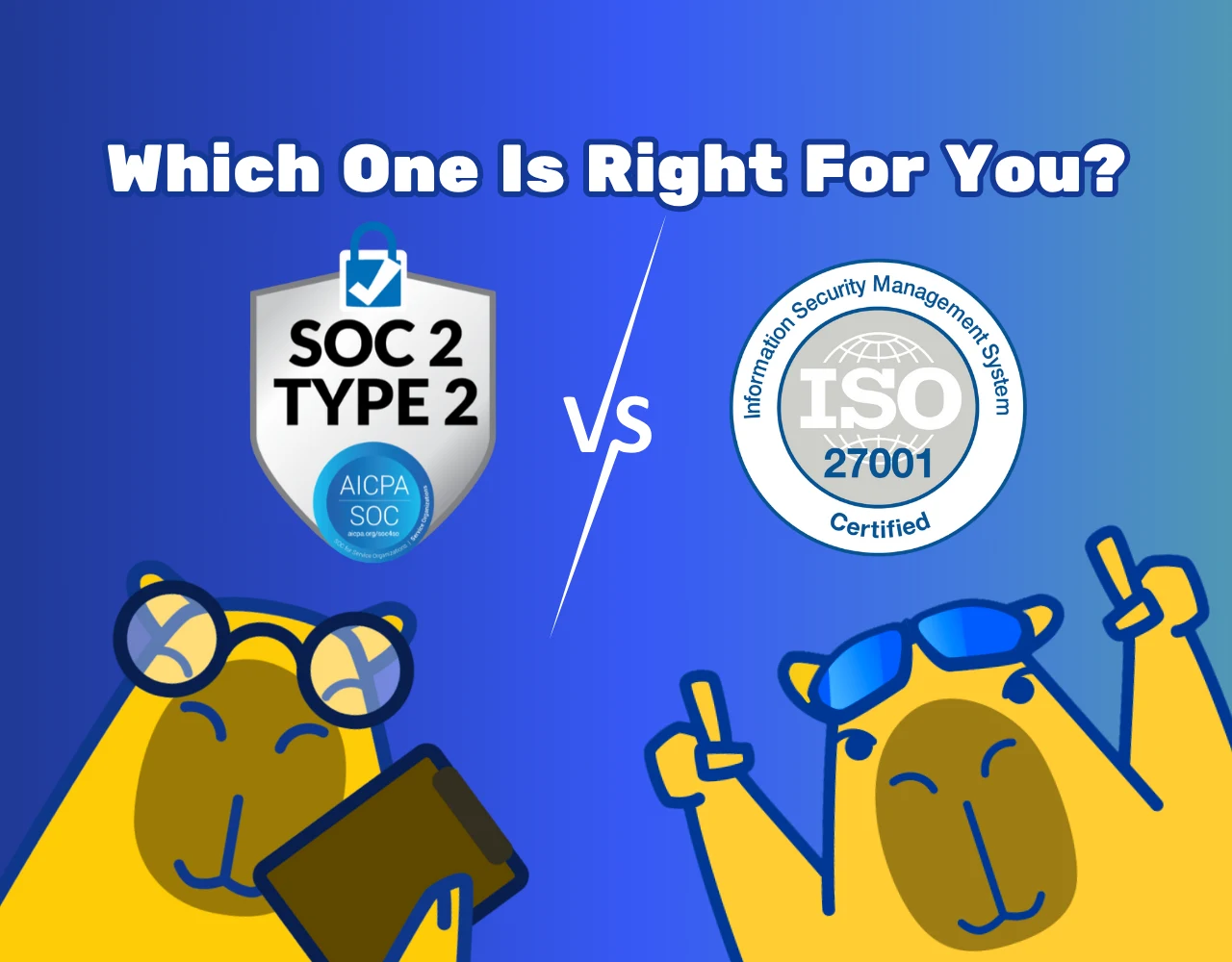
You earned your SOC 2 report. Controls are in place. Evidence is flowing. Sales stopped stalling on security questionnaires. Now leadership is looking at Europe, financial services, or bigger RFPs and asking the next obvious question: How do we step up to ISO 27001 without blowing up our team or our timeline?
This is the playbook. It shows exactly how to evolve a mature SOC 2 program into a certified ISO 27001 information security management system. You will see what to keep, what to add, what to rewrite, and how to sequence audits so you reuse work instead of duplicating it. The language is blunt because the stakes are real. You are either building a system that scales trust across markets or you are setting yourself up for another last-minute scramble every audit season.
The Mindset Shift
SOC 2 proves your controls work. ISO 27001 proves your management system keeps them working.
SOC 2 is evidence heavy, outcome focused, and flexible by design. ISO 27001 is governance heavy, process focused, and explicit about continual improvement. Think of ISO as installing the operating system for security, with management review, internal audit, risk treatment, and corrective actions running on a clock.
If you keep treating compliance as a project, you will burn out your team. If you run it as a system, you will scale across regions and frameworks with less effort each year.
Why Move from SOC 2 to ISO 27001
Global Credibility
ISO 27001 is the language of procurement in Europe and APAC. For many buyers it is the baseline.
Program Durability
A certified ISMS forces you to institutionalize the habits that keep controls healthy.
Portfolio Runway
The ISO ecosystem gives you clean on-ramps to ISO 27701 for privacy, 27017 for cloud, and 27018 for PII in the cloud.
Audit Harmonization
SOC 2 and ISO 27001 overlap substantially. If you plan correctly, you will not double the work.
Where You Are Today with SOC 2
A strong SOC 2 program already gives you most of the technical foundation ISO expects:
- •Access control, logging, change management, incident response, vulnerability management, business continuity elements, vendor risk, and training
- •Evidence pipelines from cloud, identity, code, and device management
- •Control owners, SLAs, and monitoring dashboards
- •A living risk assessment, even if it is lighter than ISO wants
You are not starting from zero. You are upgrading.
The Gaps You Must Close for ISO 27001
ISO 27001 certification lives and dies on governance. These are the additions that move you from "controls work" to "ISMS works."
1. ISMS Scope and Context
- •Define what information, systems, locations, and business processes are in scope
- •Identify interested parties and their requirements
- •Document assumptions and interfaces so there is no ambiguity
2. Formal Risk Methodology and Risk Register
- •Pick a method and stick to it: likelihood, impact, inherent vs residual, risk acceptance criteria
- •Tie every treatment to Annex A controls or justified alternatives
- •Show repeatability with versioned registers and review dates
3. Statement of Applicability (SoA)
- •The centerpiece of ISO 27001
- •For each of the 93 Annex A controls, state whether it applies and why
- •Link every applied control to evidence and operating procedures
4. Policies with ISO Language and Intent
Your SOC 2 policies likely cover the ground but rewrite to align with ISO clauses and Annex A themes
5. Internal Audit
- •Plan, perform, and record an internal audit against the full ISMS before the certification audit
- •Track findings, root causes, and corrective actions
6. Management Review
- •Leadership reviews ISMS performance on a defined cadence
- •Inputs include KPIs, risk changes, incidents, audit results, supplier performance, opportunities for improvement
- •Minutes are taken and actions are assigned
7. Corrective Action and Continual Improvement
- •Formalize how you raise, triage, correct, and verify issues in the ISMS
- •Show closed-loop evidence that problems do not repeat
8. Supplier Evaluation and Monitoring
SOC 2 covers vendors, but ISO expects a documented supplier lifecycle with criteria, onboarding, review triggers, and termination steps
9. Competence and Awareness
Training is not just completion rates. Define roles, competencies, training plans, and measures of effectiveness

Ready to Implement ISO 27001?
Enter your email to receive a Free ISO 27001 Preparation Checklist and start your compliance journey today.
Control and Evidence Mapping That Actually Saves Time
Do not stop at theory. Map controls and map the exact evidence objects you will reuse:
- •Access reviews. Quarterly reviews for SOC 2 map to ISO Annex A.5 and A.8 family controls. Reuse review exports, tickets, and approvals.
- •Change management. PR approvals, build logs, and deployment checks for SOC 2 map to ISO controls on change and secure development.
- •Vulnerability scans and patching. Reuse outputs, exceptions, SLAs, and remediation tickets for Annex A technology controls.
- •Incident response. Drill records, postmortems, lessons learned, and updates to playbooks satisfy both frameworks.
- •Vendor risk. Due diligence records, DPAs, and monitoring events map to Annex A supplier controls and SOC 2 vendor criteria.
Create a single evidence catalog with owners, systems of record, refresh frequency, and where auditors can find each artifact. Your audit week will feel very different.
A Practical 16-Week Roadmap from SOC 2 to ISO 27001
This is a realistic plan for a team that already runs SOC 2 Type II and wants ISO 27001 certification without killing velocity.
Weeks 1-2: Plan and Scope
- •Name an ISMS Manager and finalize RACI
- •Confirm scope boundaries, assets, and interfaces
- •Pick your risk method and acceptance criteria
- •Lock an auditor and dates for Stage 1 and Stage 2
Weeks 3-6: Build the ISMS Backbone
- •Draft or rewrite top-level policies to align with ISO clauses
- •Stand up the risk register with initial analysis
- •Draft the SoA skeleton with preliminary applicability decisions
- •Define management review inputs and schedule the first session
- •Design the internal audit plan
Weeks 7-9: Integrate with Operations
- •Connect policy to practice: ensure every control has procedures, owners, KPIs, and evidence sources
- •Close technical gaps against Annex A controls using your existing SOC 2 implementations whenever possible
- •Tighten supplier lifecycle documentation and records
- •Prepare training updates and role competency matrices
Weeks 10-11: Internal Audit and Corrective Actions
- •Run an internal audit against the ISMS
- •Log findings, assign corrective actions, verify fixes
Week 12: Management Review
- •Conduct the first management review with leadership
- •Record decisions, approve SoA, green-light Stage 1
Week 13: Stage 1 Audit
- •Documentation and readiness check
- •Expect minor findings around wording, linkages, or scope clarity
- •Close them quickly
Weeks 14-15: Final Hardening
- •Address Stage 1 observations
- •Validate evidence freshness and traceability across controls
Week 16: Stage 2 Audit
- •Dry-run interviews with control owners
- •The live test of implementation and effectiveness
- •Walkthroughs, sampling, and interviews across the ISMS
- •If nonconformities appear, drive corrective actions with clear root cause and verification
Align your SOC 2 Type II observation window so key evidence collection periods overlap this 16-week arc. It will reduce duplication and audit fatigue.
Common Pitfalls and How to Avoid Them
ISMS on paper. If your procedures do not match how teams work, findings follow. Fix the process, not only the document.
SoA that is a copy-paste. Applicability must make sense for your business. Auditors can tell when the rationale is generic.
Stale evidence. Define refresh intervals per control. Automate where possible.
No corrective action muscle. Close the loop with root cause, fix, and verification.
Management review as a checkbox. Bring real metrics, risks, incidents, and supplier insights. Capture decisions and actions.
Unowned controls. Every control needs a DRI and a backup. Shared ownership hides gaps.
Vendor sprawl. Formalize supplier onboarding, reviews, and termination. Keep a single source of truth.
Budget and Timeline You Can Defend
A realistic first certification cycle looks like this for a SOC 2-mature SaaS:
Timeline
16 weeks to Stage 2 if you move with focus and reuse SOC 2 evidence.
External Audit Fees
Often $10,000 to $50,000 USD for ISO 27001, depending on scope and size.
Internal Time
Concentrated effort from security, platform, IT, legal, and HR. Automation can cut manual evidence work by half or more.
The Payoff
Scaling from SOC 2 to ISO 27001 is not busywork. It is how you turn a good security program into a durable operating system for trust. Done right, you will shorten procurement cycles across regions, reduce incident risk, and give your teams a single, predictable way to run compliance without constant heroics.
If you want the fastest route without bloating headcount, use automation to keep controls live, evidence current, and audits predictable. One control set. One evidence catalog. Two frameworks covered. And a security story that keeps opening doors as you grow.
How Smartly Helps You Win ISO 27001 Fast
Getting from SOC 2 to ISO 27001 doesn't have to be slow, expensive, or consultant-heavy. Smartly was built precisely for this moment: the jump from point-in-time compliance to full-scale certification.
Reuse up to 80% of your SOC 2 work through automatic control and evidence mapping to ISO 27001 Annex A
Automate evidence collection across your cloud, HR, and engineering systems, cutting prep time by weeks
Generate auditor-ready documents: policies, risk register, Statement of Applicability, and ISMS scope with templates tailored to ISO 27001:2022
Track audit readiness in real time through dashboards that show which controls are ready, which need attention, and which are already verified
Startups and scale-ups using Smartly have reached ISO 27001 certification up to 60% faster than traditional approaches, often completing Stage 1 and 2 audits within a single quarter.
If your team has already proven itself with SOC 2, Smartly is the easiest way to turn that foundation into a global ISO 27001 win — fast, clean, and audit-ready.